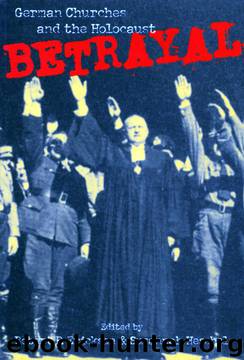
Betrayal: German Churches and the Holocaust by Robert P. Ericksen
Author:Robert P. Ericksen
Language: eng
Format: epub
Published: 2011-04-21T08:49:00+00:00
A Call to Obedience
As Bonhoeffer's life progressed, he passed eventually through all three themes introduced in his essay of 1933. However, during the next two years, his work centered on the church's stand regarding Christian Jews. Historians are now beginning to recognize that the German church struggle, as it progressed in 1933 and 1934, took place not because Protestant church leaders repudiated the politics of the Nazi regime. It involved instead a power struggle over who would control the church. The key test concerned the application of Nazi racial policy to the personnel and membership of the Protestant churches. As the summer of 1933 progressed, Bonhoeffer took a stronger position than anyone in his church in opposition to these measures against Christian Jews. In June, before a large crowd of students at the University of Berlin gathered to debate contemporary church politics, Bonhoeffer countered the German Christian Professor Fabricius, who insisted on the need to maintain the purity of the German gospel and to resist "judaizing." Bonhoeffer responded that only those who were weak in their faith need to eject people from their congregation; the weak need a racial law, he said, the strong do not." Also in June, the Gestapo threatened to arrest Bonhoeffer and his friend Gerhard Jacobi if they would not stop canvassing for the upcoming July church elections against the German Christians and their plan to base the church on race."
After the disastrous church elections in July, in which German Christians took over leadership in Bonhoeffer's church, the Old Prussian Union, the new leaders made good on their threats and proposed that the Aryan Paragraph become church law. Bonhoeffer drafted a leaflet, circulated among pastors and congregations in his district, in which he spoke in strong language against the exclusion of non-Aryan clergy from the church and denounced the German Christian proposal to segregate Jewish Christians into their own congregations.'" Shortly after he wrote the pamphlet, the Young Reformation Movement, the association of pastors who had opposed the German Christians in the church elections, chose Bonhoeffer and Hermann Sasse, a theology professor at Erlangen University, to draft a confessional statement for the national synod planned for later in the fall. The two met in August at Bethel, near Bielefeld. Bonhoeffer had never before visited Bethel, the most famous home in Germany for the mentally and physically handicapped, and was stunned by the experience. From Bethel he wrote prophetically to his grandmother: "It is sheer madness to believe, as is done today, that the sick can or ought to be legally eliminated. It is virtually the same as building a tower of Babel, and is bound to bring its own 1121
The purpose of this Bethel Confession, authored by Bonhoeffer and Sasse, was to force a confrontation with the German Christians over the intrusion of racist, nationalistic ideology into the traditional Lutheran theology of the church. Part of the confession would respond to the Aryan Paragraph. Wilhelm Vischer, a teacher at the Bethel School of Theology, assisted Bonhoeffer and drafted the article on the Jewish question.
Download
This site does not store any files on its server. We only index and link to content provided by other sites. Please contact the content providers to delete copyright contents if any and email us, we'll remove relevant links or contents immediately.
| Africa | Americas |
| Arctic & Antarctica | Asia |
| Australia & Oceania | Europe |
| Middle East | Russia |
| United States | World |
| Ancient Civilizations | Military |
| Historical Study & Educational Resources |
Cecilia; Or, Memoirs of an Heiress — Volume 1 by Fanny Burney(32558)
Cecilia; Or, Memoirs of an Heiress — Volume 2 by Fanny Burney(31956)
Cecilia; Or, Memoirs of an Heiress — Volume 3 by Fanny Burney(31942)
The Secret History by Donna Tartt(19088)
Sapiens: A Brief History of Humankind by Yuval Noah Harari(14389)
Leonardo da Vinci by Walter Isaacson(13336)
The Radium Girls by Kate Moore(12028)
Sapiens by Yuval Noah Harari(5370)
How Democracies Die by Steven Levitsky & Daniel Ziblatt(5219)
The Wind in My Hair by Masih Alinejad(5095)
Homo Deus: A Brief History of Tomorrow by Yuval Noah Harari(4918)
Endurance: Shackleton's Incredible Voyage by Alfred Lansing(4783)
Man's Search for Meaning by Viktor Frankl(4606)
The Silk Roads by Peter Frankopan(4534)
Millionaire: The Philanderer, Gambler, and Duelist Who Invented Modern Finance by Janet Gleeson(4478)
The Rape of Nanking by Iris Chang(4213)
Joan of Arc by Mary Gordon(4111)
The Motorcycle Diaries by Ernesto Che Guevara(4102)
Stalin by Stephen Kotkin(3966)
